
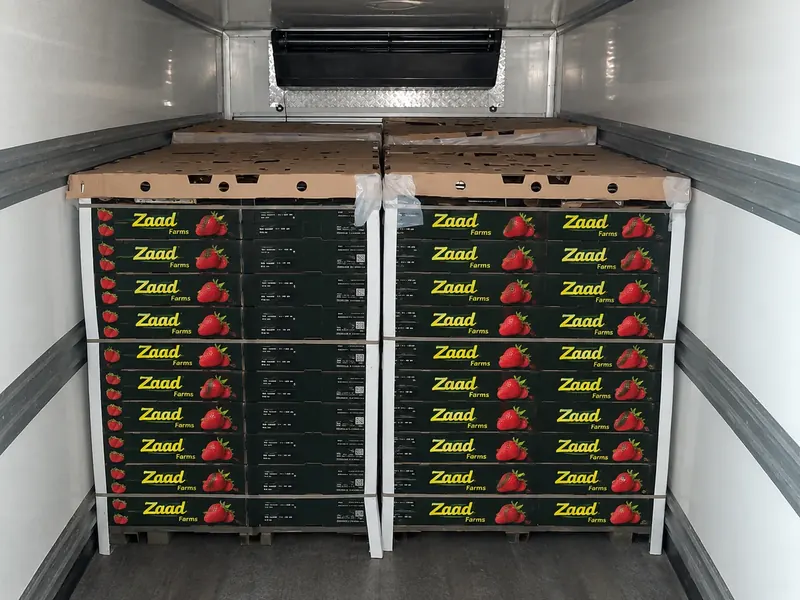
Cold-chain planning starts with the product and its approved handling specification. Each fruit and vegetable has its own ideal temperature and humidity; some are damaged by cold, others spoil quickly if too warm. This guide lists typical settings and good practice. Final set-points should always be agreed per programme, variety and voyage.
Typical carrying conditions
| Product | Temperature | Humidity |
|---|---|---|
| Table grapes | −0.5 to 0 °C | 90–95% |
| Strawberries | 0 to +1 °C | 90–95% |
| Broccoli, lettuce, carrots | 0 to +1 °C | 95%+ |
| Oranges | +3 to +5 °C | 85–90% |
| Mandarins | Per variety (often +4 to +7 °C) | 90–95% |
| Onions | +2 to +4 °C (or ventilated) | 65–70% |
| Table potatoes | +4 to +6 °C | 90–95% |
| Processing potatoes | +8 to +10 °C | 90–95% |
| Peppers, cucumbers, eggplants | +7 to +12 °C | 90–95% |
| Mangoes, grapefruit | +10 to +13 °C | 85–90% |
| Sweet potatoes | +13 to +15 °C | 85–90% |
| Frozen products | −18 °C or colder | — |
These are typical values from industry practice. Your importer, carrier and our export team should confirm the set-point for each shipment.
Five rules for a reliable cold chain
1. Pre-cool before loading
A reefer maintains temperature; it cannot quickly remove field heat. Produce should reach its target pulp temperature in cold storage before loading.
2. Pre-trip the container
The reefer should be pre-cooled and checked before it arrives at the packhouse, with the correct set-point, ventilation and humidity settings.
3. Load for airflow
Do not load above the red line, leave the floor channels clear and keep pallet vents aligned. Cover empty floor space so air flows through the load, not around it.
4. Record temperature
Temperature recorders in the load show what happened in transit and are essential if there is a claim.
5. Do not mix incompatible products
Products that need different temperatures, or ethylene-producing fruit with ethylene-sensitive vegetables, should not share a container just because there is space.
Cold-treatment protocols
Some destinations require citrus and other fruit to be held at a specified low temperature for a set number of days in transit to control fruit flies. These protocols use calibrated probes and certified containers, and must be agreed before booking.
Frequently asked questions
Can oranges and grapes share a container?
Usually not. Grapes need −0.5 to 0 °C and SO₂ protection, while oranges travel at +3 to +5 °C.
What is pulp temperature?
The temperature inside the fruit, measured with a probe. It should reach the target before loading.
Do onions need a reefer?
Not always. Many onion programmes use ventilated containers; reefers are used on longer or hotter routes.